
|
|
In 56 BC. Conn
and Beowulf made their way to Rome and after a few troubles at the Gaulic
border, they arrived at Rome to marvel at its beauty and splendor. Using
the gold and jewelry they aquired at Doom’s tomb, they made a nice living
for themselves for some time, until they were contacted by a thief, Taurus
( who was rebuffed ) and later by Publius and Calius, who were thugs for
the citadine army of Gaius Julius Caesar. The characters accepted the invitation
of the two romans and joined Caesar’s gang. In the gang they met Valeria,
a beautiful redhead who immediately took a liking to them and Juma, a giant
black warrior from the south, whom they soon suspected to be an immortal.
In little time
they were leading the gang and got in touch with Senator Trocero, who in
turn presented them to another immortal, Marcus Ramius, who was to take
part in the battles against the gang of Pompeus.
Around 55 BC
they discovered that the cult of Set was allied to Pompeus, who is Caesar’s
opponent in the gang wars. A plan was then devised in which Beowulf would
infiltrate the cult of Set in Rome to find out who were the leaders of
the cult. Meanwhile Conn faces two Serpent Men, incredibily fast and agile
warriors, on the side of Pompeus.
In 53 BC Beowulf
entered the inner circle and got to know the Heads of the Cult of Set.
They then planned an attack on the main temple, even though all worried
that Beowulf could be too influenced by Set to act on their side. Anyway,
they invaded the temple and killed all priests-sorcerers but one, Gneus
Iocles, who managed to escape, through a tiny tunnel to the sewers. The
Church of Mighty Set was destroyed in Rome.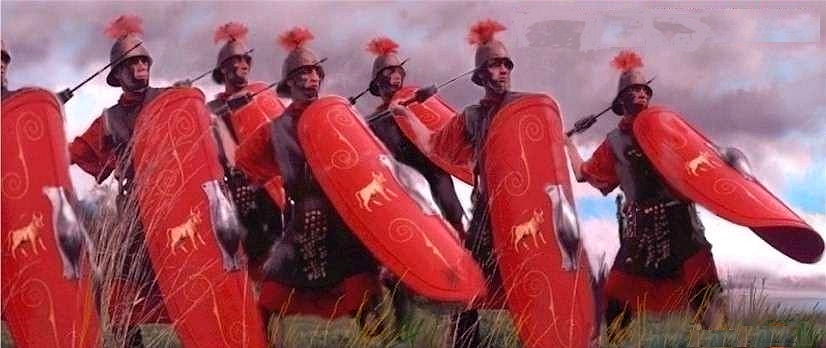
In 52 BC the
gang armies in Rome were disbanded by an army led by Pompeus. Senator Trocero
rewarded the four ( Beowulf, Conn, Juma and Valeria ) with a great Domus
as well as an annual stipendium that made them VERY wealthy and asked the
men to report to Caesar in the north of Gaul, where he was completing his
conquest. There, they met the great General as well as Marcus Antonius
and Otavianus, their lieutenants, and an ancient counsellor, Claudius Pertinaz.
They then received
from Caesar an order to take care of a grandnephew of his that was to come
to the northern border to take command of a cohort. When Lucius Maximus
Julius arrived, they noticed they would have a lot of work with the brat,
as he ordered Beowulf, Conn and Juma: “Savages, look after my horses”;
but after a few lessons, Lucius was to be tamed. Another event that helped
instill some sense into him was an attack by a gaulic warrior who turned
into dust after having beeen defeated by Beowulf.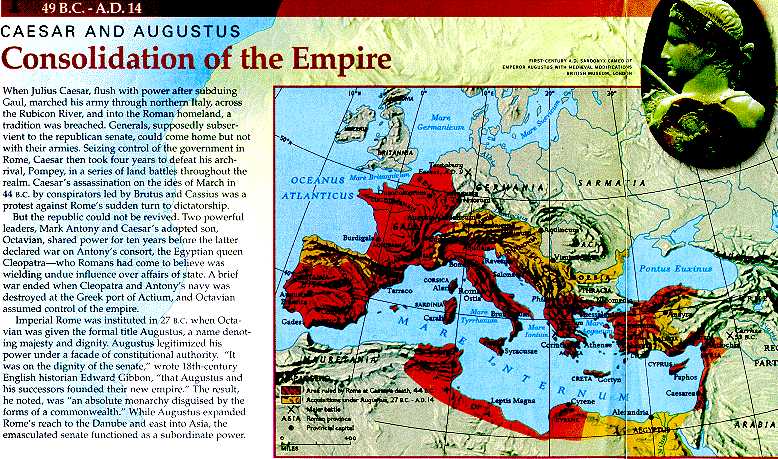
They watched
as the commander of the Gaul forces, Vercingetorix, deposed his arms before
Caesar. They saw him say the words: “Vini, Vidi, Vinci” and they departed
with him to Britain to continue his glorious conquests. In Britain, they
were soon met by eleven celt chieftains who pledged their loyalty
to Caesar and that was when Caesar received his orders to return to Rome,
alone.
He didn’t return
alone but with his army and, as they crossed the Rubicon, he said: “alea
jacta est”, as thereafter, only the Gods knew his fate. However, as Caesar
arived at Rome, Pompeus had already left for he new that Caesar's veterans
were unbeatable. Pompeus's plan was to bottle Caesar up in Italy and starve
him out, but Caesar, in a lightning sweep, seized Massilia and Spain from
Pompeus' commanders, then crossed into Greece, where a short campaign ended
in Pompeus' decisive defeat at Pharsalus in 48 BC. Pompeus fled to Egypt,
where he was assassinated by a man hoping thus to curry Caesar's favour.
This was by no means the end of the war. Almost at once Caesar was nearly
trapped at Alexandria, where he had intervened in a succession dispute;
but he escaped and installed Cleopatra on the throne, for personal as well
as political reasons. In Africa the Pompeian forces and their native allies
were not defeated until Caesar himself moved against them and annihilated
them at Thapsus. In Spain, where Pompeus' name was still powerful, his
sons organized a major rising, which Caesar himself again had to defeat
at Munda in 45 BC in the bloodiest battle of the war. By the time he returned,
he had only a few months to live.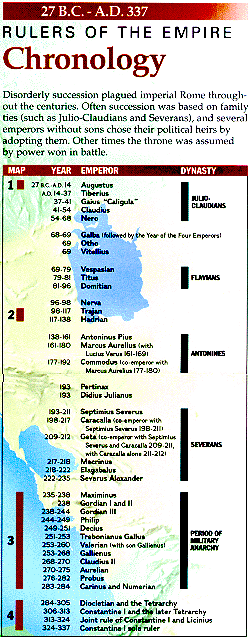
For a time,
honourable men, such as Cicero, hoped that the "Dictator for Settling the
Constitution" (as Caesar called himself) would produce a real constitution--some
return to free institutions. By late 45 that hope was dead. Caesar was
everywhere, doing everything to an almost superhuman degree. He began to
accept more and more of the honours that a subservient Senate invidiously
offered, until finally he reached a position perilously close to kingship
(an accursed term in Rome) and even deification. Whether he passed those
hazy boundary lines is much debated and not very important. He had put
himself in a position in which no Roman ought to have been and which no
Roman aristocrat could tolerate. As a loyal friend of his was later to
say: "With all his genius, he saw no way out." To escape the problem or
postpone it, he prepared for a Parthian war to avenge Crassus--a project
most likely to have ended in similar disaster. Before he could start on
it, about 60 men--former friends and old enemies, honourable patriots and
men with grievances--struck him down in the Senate on March 15, 44 BC.
The characters accompanied Caesar closely through all his battles and political
maneuvers, but in the Senate they could not protect him.
As new forces
began to emerge, the characters joined the one chosen by Caesar, Octavian,
whom they had already met in Gaul and to whom Lucius was cousin. Octavian
had been adopted as son and heir by Caesar and he rose as a challenger
against Mark Antony, the surviving consul, who gradually gained control
of the city and the official machinery. Octavian, however, though not yet
20, proved an accomplished politician; he attracted loyalty as a Caesarian
while cooperating against Antony with the Senate, which, under Cicero's
vigorous leadership, now turned against the consul. Cicero hoped to fragment
and thus defeat the Caesarian party, with the help of Brutus and Cassius,
who were making good progress in seizing control of the eastern provinces
and armies. In 43 the two consuls (both old Caesarian officers) and Octavian
defeated Antony at Mutina, and success seemed imminent. But the consuls
died, and Octavian demanded and, by armed force, obtained the consulship;
and the armies of Italy, Spain, and Gaul soon showed that they would not
fight against one another. Octavian, Antony, and Lepidus (the senior Caesarian
with an army) now had themselves appointed "Triumvirs for Settling the
Constitution" for five years and secured control of Italy by massive proscriptions
and confiscations (Cicero, Antony's chief enemy, was among the first to
die). They then defeated and killed Brutus and Cassius at Philippi in 42
and divided the Roman world among themselves, with Lepidus, a weak man
accidentally thrust into prominence, getting the smallest share. Octavian,
who was to control Italy, met armed opposition from Antony's brother and
wife, but they got no help from Antony and were defeated at Perusia in
41. Octavian and Antony sealed their alliance with a marriage compact:
Antony married Octavia, Octavian's sister. Octavian then confronted Pompeus'
son Sextus Pompeius, who had seized control of the islands off Italy. After
much diplomatic maneuvering (including another meeting with Antony), Octavian
attacked and defeated Sextus; when Lepidus tried to reassert himself, Octavian
crushed him and stripped him of his office of Triumvir (while with conspicuous
piety leaving him the chief pontificate, now an office without power).
Octavian now controlled the West and Antony the East, still officially
as Triumvirs (their term of office had been extended), even though Lepidus
had been eliminated in 36.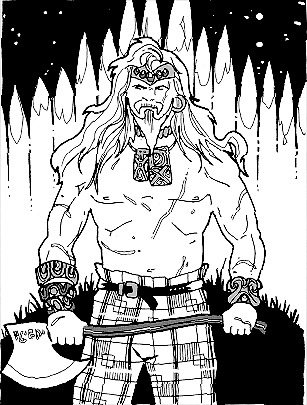
Each of the
two leaders embarked on campaigns and reorganization in his half--Octavian
in Illyricum, Antony particularly on the Parthian frontier. But Antony
now married Cleopatra and tried to make Egypt his military and political
base. In a war of propaganda, Octavian gradually convinced the western
provinces, Italy, and most of the Roman upper class that Antony was sacrificing
Roman interests, trying to become a Hellenistic king in Alexandria, and
planning to rule the Roman world from there with Cleopatra. In 32, though
he now held no legal position, Octavian intimidated most of Antony's remaining
aristocratic friends into joining him, made the whole West swear allegiance
to himself, and in 31, as consul, crossed into Greece to attack Antony.
On September 2 he defeated Antony and Cleopatra in a naval battle at Actium.
Though in itself not a major victory, it was followed by the disintegration
of Antony's forces, and Antony and Cleopatra finally committed suicide
in Alexandria in 30 BC.
Again the characters
took part in all battles on the side of Octavian and by that time, they
even had some counsel to give him in terms of politics ( in strategic terms
they were his commanders ). After so much ease, the characters convinced
Otavianus Augustus to prohibit the faith of Set throughout the empire.
They went down to Egypt to enforce the law but met no resistance there.
In 25 BC, they
decided to go to their homes for a little time and the Emperor relieved
them, as nothing important enough was brewing in Rome. Back home, they
found things much the same and after greeting the girls, they went after
Legolas, who had seemingly travelled to find the ancient Norse Sidhe family,
the Asgardians.
After moving
to the North, they finally found the tribe of the Asgardians, Sidhes
who ruled over all north Europe. They were divided into the Aesir and Vanir,
and they called their home Valhalla.
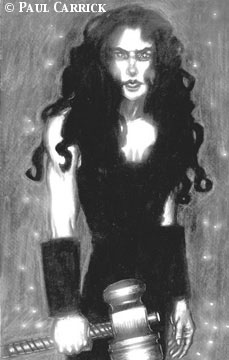
The Aesir were
Odin, or Wotan, their leader, Frigg, his wife, Thor, his son, and Sif,
Heimdall, Balder, Loki, Volstagg, and others. The Vanir were in smaller
numbers and were led by Njord of the Sea and his son Freyr and daughter
Freya. Beowulf, Juma, Valeria and Lucius were more taken with the Aesir,
while Conn was received well among the Vanir.
After spending
some time with the Asgardians, and learning that Legolas had indeed
passed some time among them and then parted north, they too moved notrthwards.
They travelled for many days until they saw the most beautiful girl waving
at them from afar. Her hair was fair and her features delicately chiseled
and she called out to them. They were all charmed by her presence and followed
her into the wilds, all except Valeria, who couldn’t stop them and didn’t
dare try to do it by force. After a long time running on the snows they
couldn’t run anymore and then two giants appeared and attacked them; the
axes of the giants almost cut them in half, but they managed to slay the
giants, but couldn’t get to the fair maiden.
They returned to the Asgardians, where through potent potions, Valeria
was soon on her feet again and they departed once more to find Legolas,
which they did after a few weeks. He had gone north to look for more Sidhes
but did not find them. He was accompanied by Lúthien, and together
they decided to return to Rome.
There Legolas
was astonished by the way Rome had changed and also by how Beowulf and
Conn had managed to make their life there. They installed themselves at
their domus and presented themselves to the Emperor. However, only a few
weeks after their arrival, they were drawn into an ambush where Beowulf
was murdered following the murder of Senator Trocero and his family. Apparently,
“they” had wanted to make it appear that the characters had killed Trocero
but in the end Conn killed the immortal who had killed Beowulf, a Gunther,
the Germanic. Now, who “they” is, is up to the characters to find out